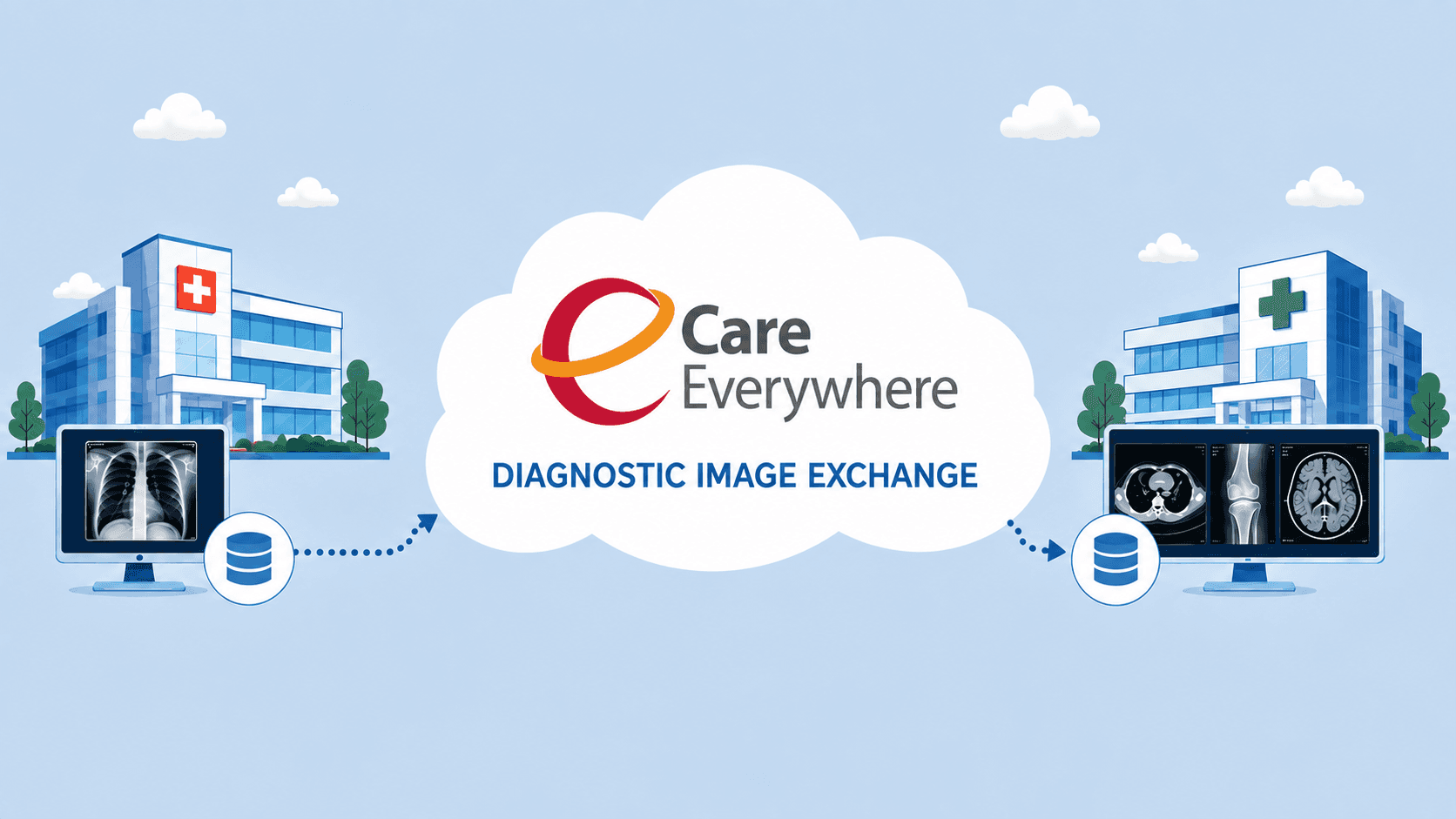
Care Everywhere Diagnostic Image Exchange allows health systems using Epic to share diagnostic-quality images including CTs, X-rays, MRIs, and more—so clinicians get the image they need to reach a diagnosis faster, and patients can start treatment sooner.
For years, organizations using Epic have been able to share written radiology reports and reference-quality images, which provide useful context with less detail than larger diagnostic-quality images that are more expensive to store. The clinician can use reference images to identify which diagnostic image they need—and now, with Diagnostic Image Exchange, the clinician can retrieve that image with one click.
Diagnostic-quality images are stored in image archiving systems outside the electronic health record (EHR). Until now, diagnostic image exchange has not used open standards, so sharing has been limited. As a result, health systems are burdened with manual image retrieval, and millions of patients across the US still carry their images on CDs from appointment to appointment.
Epic is closing that gap. Using open image exchange standards and Epic’s existing interoperability pipelines, Care Everywhere can now transport diagnostic-quality images between health systems’ image archiving systems.
“Care Everywhere Diagnostic Image Exchange empowers clinicians to deliver faster care and eliminates administrative burden,” said Matt Doyle, Epic’s director of interoperability. “We’re the first to embrace open image-sharing standards at scale, and we’re advocating for TEFCA—the federally sponsored interoperability framework—to embrace these standards so that any health system in the United States can exchange diagnostic images.”
Patients sometimes undergo a scan they’ve already had, because their clinician doesn’t know it was done elsewhere—delaying treatment and adding unnecessary radiation exposure. Epic’s duplicate-order checks have long flagged imaging already performed at another organization. Those flags prevent more than 21,000 repeat scans each year. Now, Diagnostic Image Exchange lets clinicians retrieve those prior images directly.
Epic released Diagnostic Image Exchange in August 2026, so it’s available across the Epic community now.