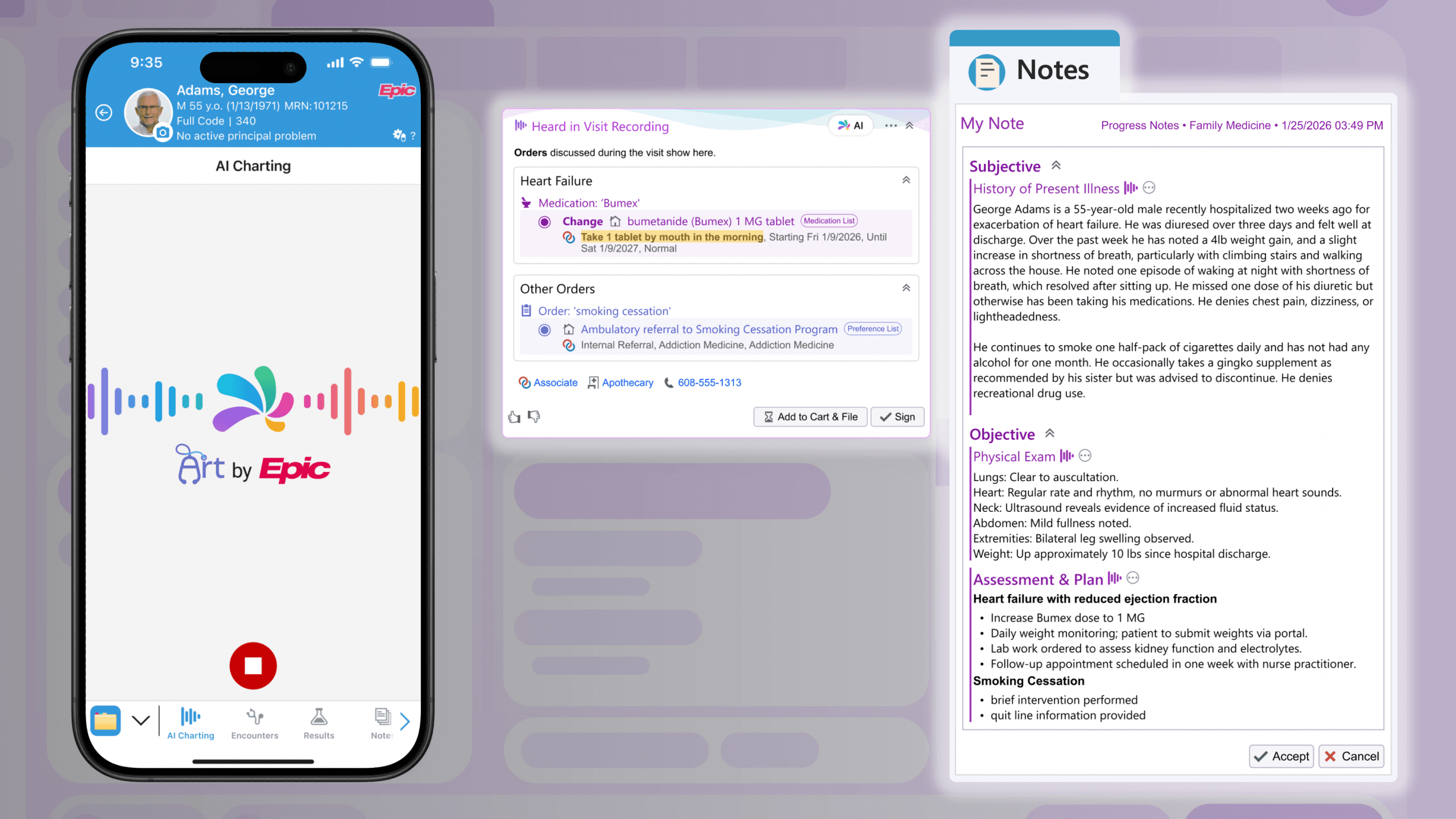
This week, Epic released AI Charting, a built-in feature that listens during patient visits, drafts the clinician’s note, and queues up orders based on the conversation. Clinicians say that by handling documentation work in real time, Epic AI Charting helps them stay focused on the patient while capturing a more complete record of the visit—reducing work after the patient leaves the room and supporting stronger patient-clinician connections.
In a customer presentation on Wednesday, Epic highlighted a growing set of AI capabilities for clinicians, patients, and hospital operations, all built directly into Epic’s software.
Supporting Clinicians at the Point of Care
AI Charting is part of Art, Epic’s AI for clinicians. In addition to drafting visit notes and suggesting orders based on the clinician-patient conversation, the initial release allows clinicians to personalize the structure of both current and future notes using voice commands, such as asking to format the history of present illness as a bulleted list.
“Our developers worked closely on site with physicians across many specialties as we created AI Charting,” Corey Miller, Vice President of R&D at Epic, said. “Feedback has been very positive, and we’re iterating quickly based on what clinicians tell us works best.”
The release of AI Charting comes as overall adoption of Art continues to grow. For example, Art’s Insights feature, which brings together information from across the patient chart into a concise, easy-to-read summary to help clinicians prepare for visits, is now used over 16 million times each month—a nearly 3x increase in usage from November 2025.
Improving Hospital Operations and Financial Performance
For hospital operations and revenue cycle teams, Penny, Epic’s AI for operational workflows, continues to deliver measurable results. More than 200 organizations now use Penny to automate professional billing coding, and many are seeing a more than 20% reduction in coding-related denials. Across organizations using Penny for medical necessity denial appeals, letters are created 23% faster.
Taken together, these features are helping organizations get paid more quickly for the care they provide.
Improving the Healthcare Experience for Patients
The presentation highlighted continued expansion of Emmie, Epic’s AI for patients, which now provides conversational assistance within MyChart and over text message. Emmie helps patients schedule appointments, understand bills, make payments, set up payment plans, and generate detailed statements for reimbursement.
By pulling together relevant account details, Emmie can explain why patients owe what they owe. Across the Epic community, organizations are seeing sustained reductions in billing-related customer service messages—allowing staff to focus on the most complex cases that require human support. When needed, Emmie can escalate patients to a live chat with a staff member.
Epic also announced that MyChart Central, which provides patients with a single Epic ID they can use across all their Epic providers, is now live in all 50 U.S. states—making it easier for patients to log into MyChart and take advantage of Emmie’s capabilities in the secure MyChart environment.
Because these AI capabilities are built directly into Epic, they draw from information captured throughout the medical record—providing answers and insights grounded in a comprehensive understanding of the patient.