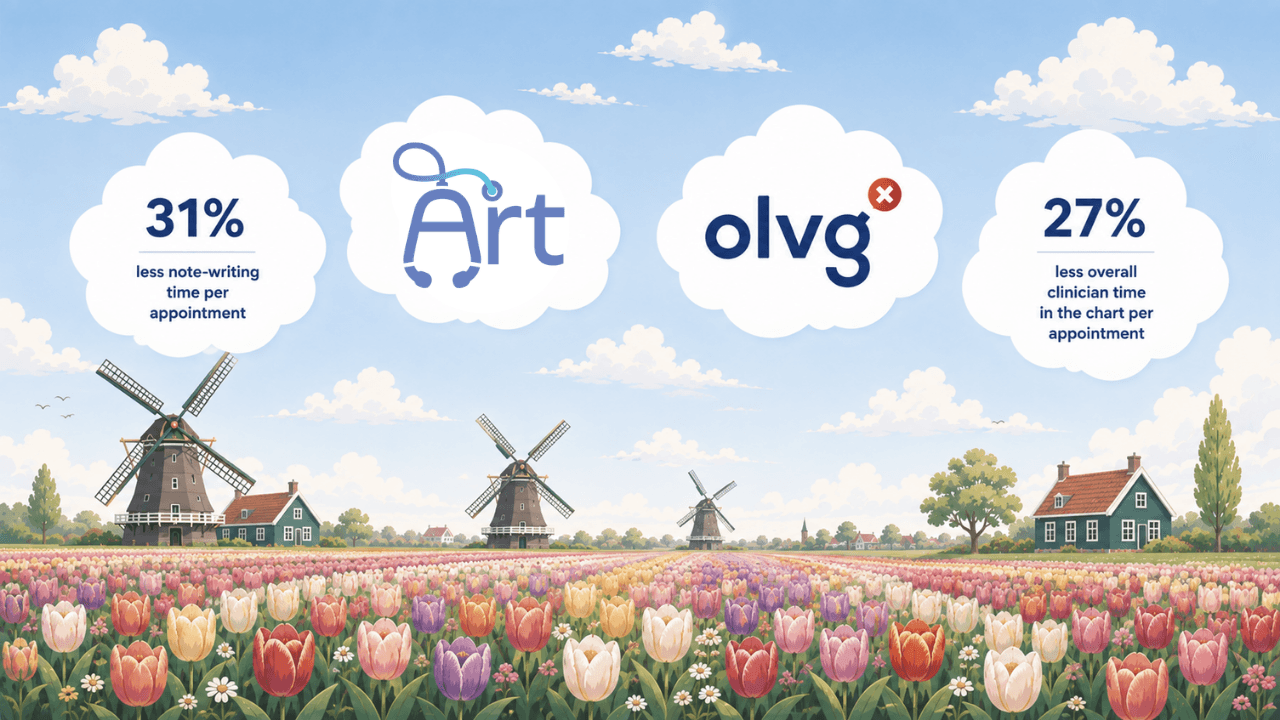
At OLVG, a major teaching hospital in Amsterdam, pediatricians have cut their note-writing time per appointment by 31% using Chart with Art.
“I would normally write my notes in the evenings and weekends, and I’m prone to forgetting things I’ve said when I do that,” said Felix Kreier, MD, PhD, a pediatrician at OLVG. “Now I can totally focus on the conversation, and I have this peace of mind that nothing will be forgotten. Even if I don’t hear something correctly, there’s a high chance that AI will pick it up. It’s much more pleasant work, and the patients enjoy it, too, because I don’t go to the computer in between.”
As Chart with Art takes notes and queues up orders in the background, clinicians can bring more focus to the conversation with the patient—and finish their next steps more quickly. In addition to note-writing time saved, overall clinician time in the chart per appointment is down by 27% at OLVG, from almost 17 minutes to just over 12 minutes.
In one case, Dr. Kreier saw a four-year-old child in the hospital’s noisy play area. The parent spoke almost no Dutch, and a translator was present to help bridge the language gap. Between the background noise, the echoes, and the competing voices, it was about as challenging an auditory environment as one could imagine. “And even with all that, Chart with Art managed perfectly to get the essence of the conversation,” Dr. Kreier said.
“Our early results suggest the biggest gains aren’t just about time, but about how clinicians feel,” said Sander van Schaik, neurologist and chief medical information officer at OLVG. “Clinicians using Chart with Art seem to experience somewhat lower mental and physical strain and less frustration, and while it’s still early, that points in a promising direction for both clinician well-being and patient attention.”
“OLVG was the first organization to use Chart with Art in Dutch, and their clinicians worked closely with our developers to get it right,” said Corey Miller, senior vice president of R&D at Epic. “It’s great to see it reducing their documentation time and helping them focus on the patient.”